

Notas do episódio
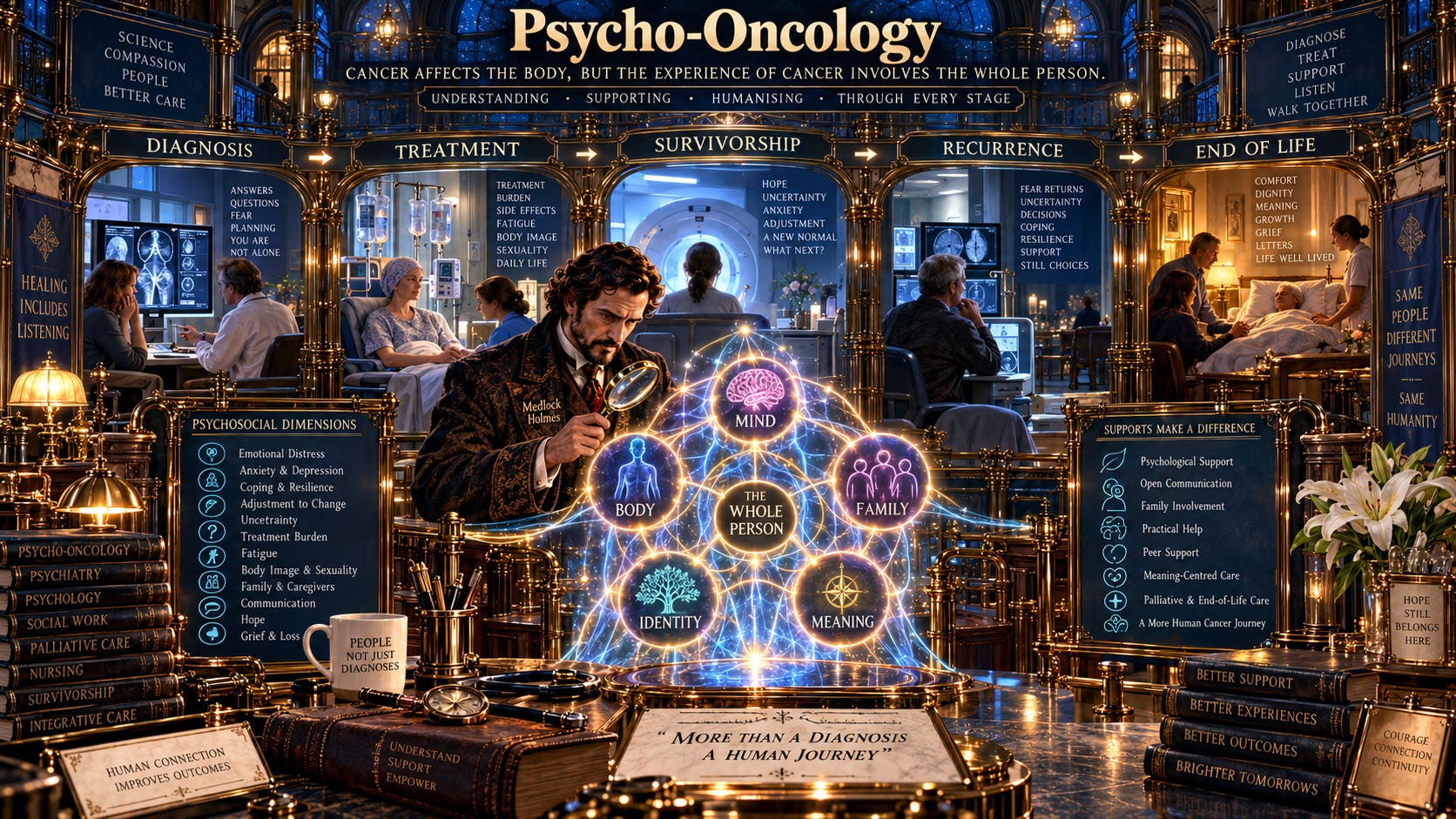
and the end of life.
Medlock Holmes enters The House of Cancer, expecting to investigate a disease of abnormal cells.
But he quickly discovers that cancer never occupies only one room.
In the laboratory, cells divide uncontrollably. In the adjoining rooms, entirely different processes are unfolding: a newly diagnosed patient sits stunned after hearing the word cancer; another cannot sleep before a surveillance scan; another is depressed during chemotherapy; a survivor is terrified that every new pain means recurrence; a parent tries to explain illness to a child; and, in the final room, a patient with advanced disease asks not simply how long they have left, but what their remaining life means.
Holmes realises that oncology treats the tumour, but psycho-oncology examines the human being who has the tumour.
Psycho-oncology sits at the intersection of oncology, psychiatry, psychology, palliative care and the wider multidisciplinary team. Its concern stretches across the entire cancer trajectory:
PREVENTION → DIAGNOSIS → TREATMENT → REMISSION → SURVIVORSHIP → RECURRENCE → ADVANCED DISEASE → END OF LIFE
At every stage, the psychological task changes.
A diagnosis may produce shock, disbelief, fear and uncertainty. Treatment introduces pain, fatigue, nausea, altered appearance, sexual difficulties and loss of independence. Remission may bring relief but also fear of recurrence. Advanced disease raises questions of mortality, meaning, dignity and hope.
Importantly, distress is not synonymous with psychiatric disorder.
Fear after a cancer diagnosis may be entirely understandable. Sadness in someone confronting loss does not automatically constitute major depression. The psychiatrist must therefore distinguish an adaptive human response from adjustment disorder, anxiety disorder, major depression, delirium or another psychiatric syndrome.
This becomes particularly difficult because cancer and its treatment can reproduce many of the somatic symptoms ordinarily used to diagnose depression:
FATIGUE • POOR SLEEP • APPETITE CHANGE • WEIGHT CHANGE • REDUCED ENERGY • IMPAIRED CONCENTRATION
Holmes therefore looks beyond symptoms alone.
He examines persistent low mood, anhedonia, hopelessness, guilt, worthlessness, withdrawal, suicidal thinking and the patient’s psychological relationship with their illness.
Anxiety is equally complex. Patients may fear treatment, procedures, pain, disfigurement, disability, recurrence or death. Some develop panic symptoms. Others experience anticipatory nausea or intense anxiety associated with chemotherapy. Cancer can also be experienced as traumatic, although fear and intrusive memories do not automatically mean PTSD.
Then Holmes encounters one of psycho-oncology’s most important diagnostic traps: delirium.
In a patient with cancer, sudden confusion or behavioural change demands a medical investigation. Infection, metabolic disturbance, organ failure, brain involvement, medications, opioids, corticosteroids and other…
Site: drmanaankarray.substack.com


