

PSYCH 166: Complementary, Alternative, and Integrative Approaches in Mental Health Care
· 1 h 0 min · Temporada 13 Episódio 166
Notas do episódio
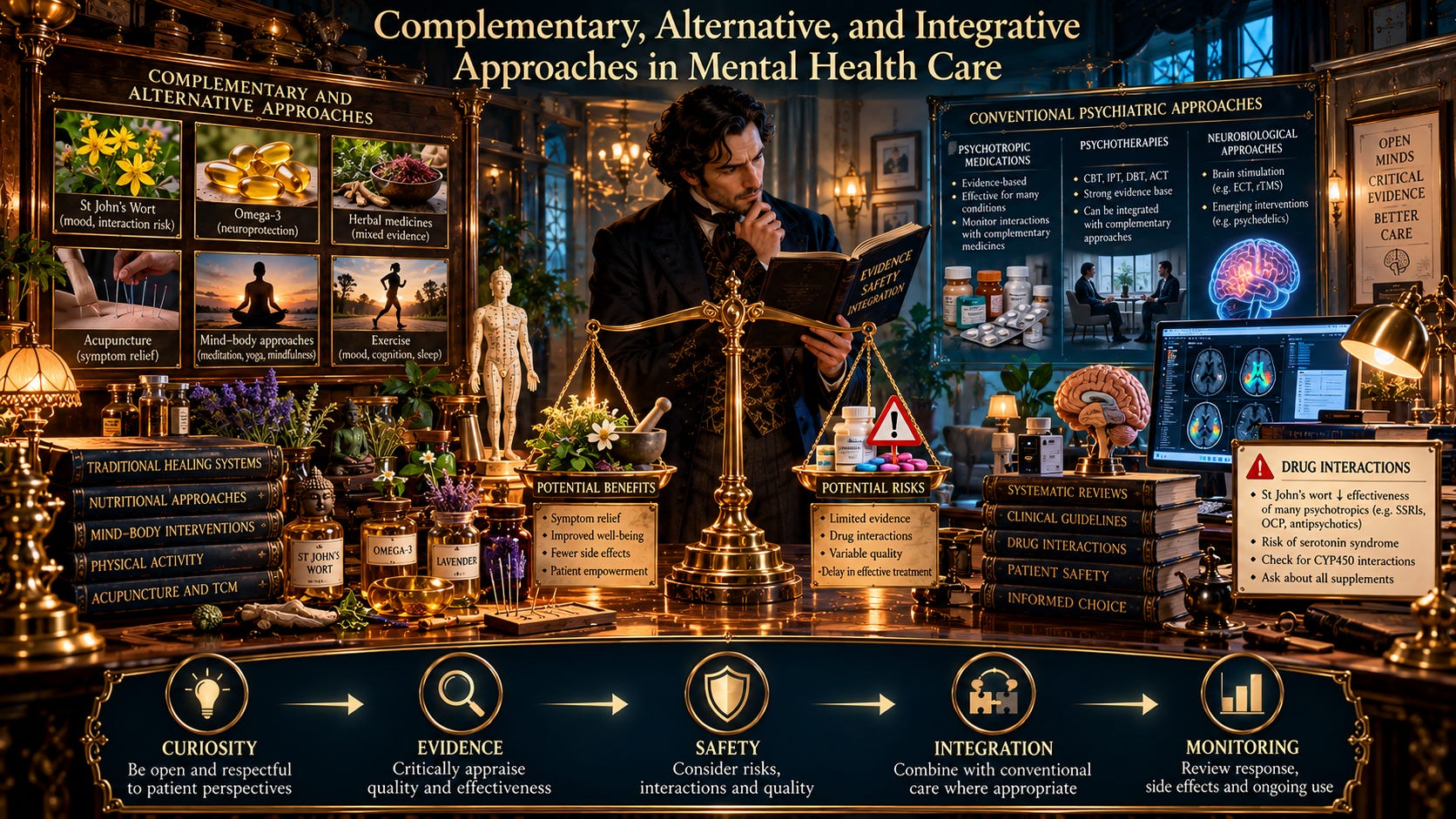
The House of Unconventional Healing
A patient arrives at Baker Street carrying two bags.
The first contains prescribed antidepressants. The second contains herbal preparations, vitamins, nutritional supplements and a handwritten list of alternative treatments.
“I thought these were natural,” she tells Medlock Holmes. “So I assumed they were safe.”
Holmes examines the bottles. Among them is St John’s wort, a herbal preparation with pharmacological effects and potentially significant drug interactions.
The patient has not mentioned any of these treatments to her psychiatrist.
Holmes realises that the most important clue is not what the patient is taking. It is what her clinician does not know.
He opens the doors to The House of Unconventional Healing, where traditional practices, modern neuroscience, nutritional medicine, psychological techniques and commercial claims compete for a place in psychiatric care.
The First Chamber: Three Paths to Healing
Holmes encounters three approaches.
Complementary medicine is used alongside conventional treatment.
Alternative medicine is used in place of conventional treatment.
Integrative medicine seeks to combine appropriate interventions within a coordinated, person-centred plan.
But Holmes refuses to accept that every combination is beneficial.
A treatment’s origins do not establish its effectiveness, and popularity does not demonstrate safety.
He writes:
TRADITION ≠ PROOF
NATURAL ≠ HARMLESS
INTEGRATION ≠ UNCRITICAL ACCEPTANCE
The Second Chamber: The Apothecary of the Mind
The next room is lined with bottles labelled omega-3, folate, vitamin D, magnesium, S-adenosylmethionine, St John’s wort, kava and melatonin.
Some contain biologically active substances with plausible mechanisms and clinical evidence.
Others are supported by small trials, inconsistent findings or speculative theories.
Holmes discovers that even promising treatments must be judged by the quality of the evidence, the clinical indication and the risk of interactions.
St John’s wort may affect the metabolism of prescribed medicines. Kava carries hepatotoxicity concerns. Serotonergic supplements may interact with antidepressants. Certain preparations may precipitate mania in vulnerable individuals.
The question is not whether a substance is natural, but whether its benefits outweigh its risks.
The Third Chamber: The Body as an Ally
Holmes enters a room filled with movement, music and light.
Here he investigates exercise, yoga, meditation, acupuncture, massage, biofeedback and nutritional approaches.
He finds an important distinction between interventions that improve general wellbeing and interventions demonstrated to treat a particular psychiatric disorder.
Exercise may support mood and physical health. Mindfulness can help some people manage distress. Bright light has established applications in circadian and seasonal mood disturbances.
Other approaches remain promising but inadequately established.
Holmes writes:
PLAUSIBILITY → CONTROLLED…
Site: drmanaankarray.substack.com


