

Notas do episódio
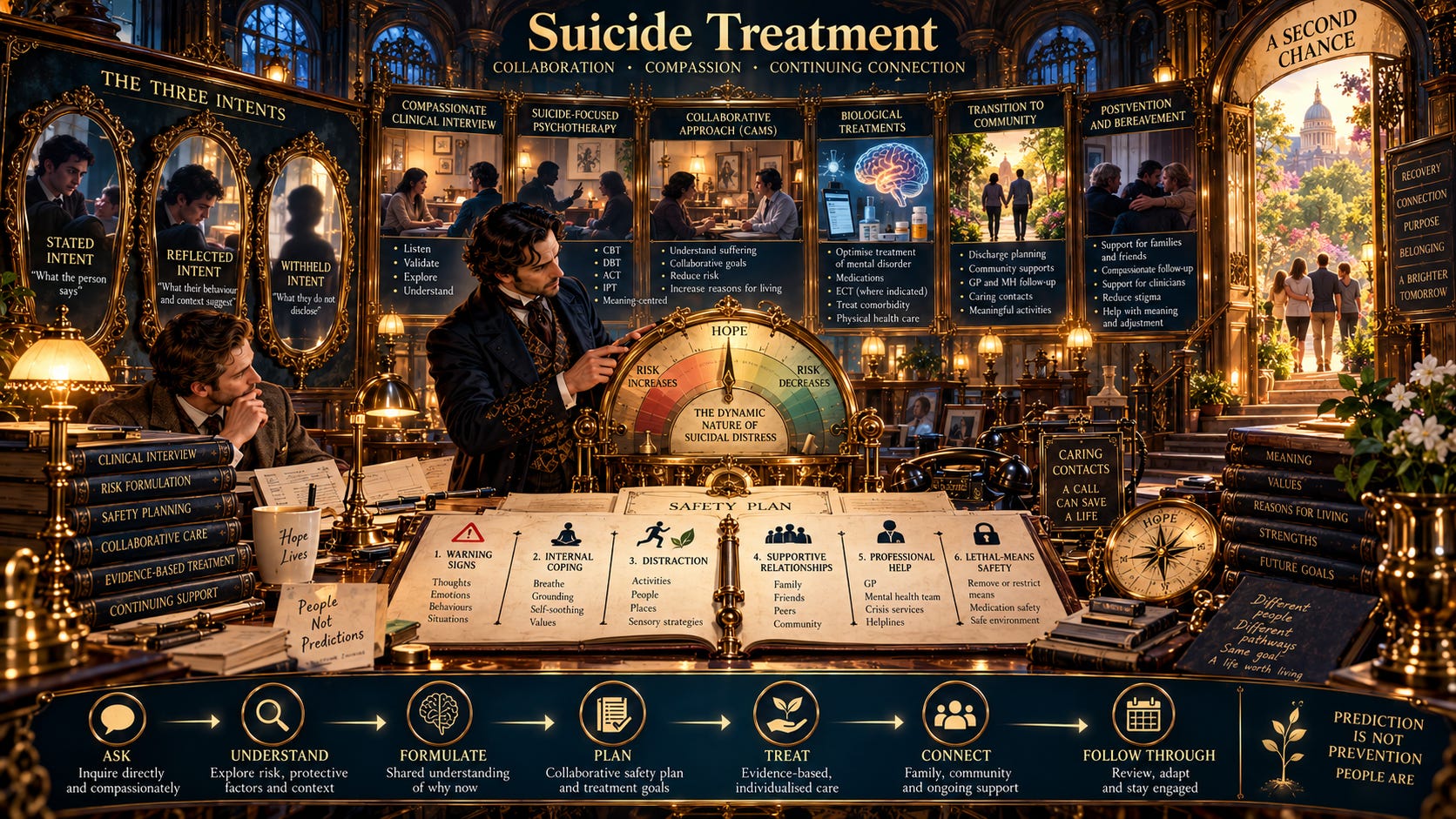
London, 1895.
A disturbing message arrived at Baker Street from St Bartholomew’s Hospital.
A young woman had survived a suicide attempt and was preparing to return home. Her physician believed that treating her depression would be sufficient. Her family believed she should remain in hospital indefinitely. The ward superintendent believed that once she denied suicidal thoughts, she could safely be discharged.
Three opinions. Three different answers. Yet none seemed to explain what would actually keep her safe.
Medlock Holmes and Watson travelled to an imposing institution known as the House of the Second Chance.
At its entrance stood a peculiar clock. Its hands did not measure hours, but the changing intensity of suicidal distress.
“Suicide risk is not a fixed characteristic,” Holmes explained. “It can change rapidly. And the purpose of assessment is not to foretell a death, but to discover what we can do to prevent one.”
In the first chamber, a physician questioned a distressed patient.
“You’re not thinking of suicide, are you?”
The patient shook his head.
Holmes stopped the examination.
“A question that asks for reassurance may receive reassurance rather than truth.”
He demonstrated a different approach: beginning with the person’s suffering, asking directly about suicidal thoughts, exploring previous experiences and gently discovering what had kept the person alive.
In the next chamber stood three mirrors.
One reflected what patients openly disclosed. Another revealed their preparations and behaviour. The third remained partly obscured, representing what they could not yet tell the clinician.
“Stated intent, reflected intent and withheld intent,” Holmes said. “A skilled interview must consider all three.”
Beyond the mirrors lay the Workshop of Safety. Here, Watson found a carefully constructed plan containing warning signs, personal coping strategies, supportive people, professional contacts and practical steps to reduce access to lethal means.
“This is not a promise never to die,” Holmes observed. “It is a practical route towards help when the mind becomes overwhelmed.”
The next rooms housed different therapeutic approaches. One contained lithium and clozapine, representing biological treatments with evidence for reducing suicidal behaviour in specific disorders. Another offered dialectical behaviour therapy and cognitive behavioural therapy. A third contained a circular table where the patient and therapist worked together through the Collaborative Assessment and Management of Suicidality.
Watson noticed that the clinicians were not merely treating diagnoses.
“They are treating suicidality itself,” he said.
“Exactly,” replied Holmes. “Depression, psychosis and other illnesses matter greatly. But the thoughts and processes driving suicide deserve direct therapeutic attention.”
At the hospital’s rear entrance, Holmes discovered the most dangerous threshold: discharge.
A brass inscription read, Why now out?
“Time spent in hospital is not…
Site: drmanaankarray.substack.com


