

Catatan episode
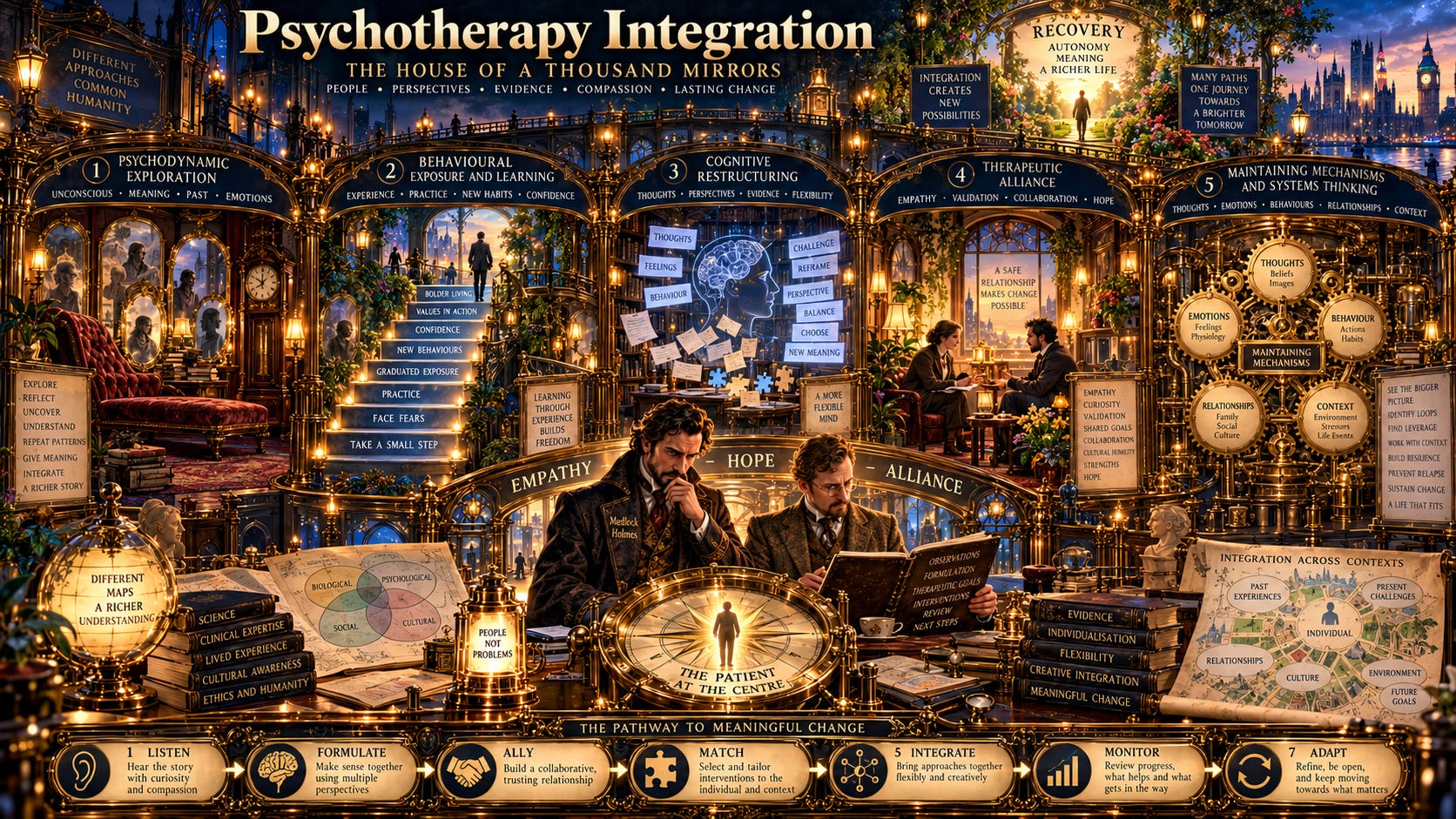
Medlock Holmes and the House of a Thousand Mirrors
London, 1895.
On a fog-laden evening, Medlock Holmes and Dr Watson received an invitation to the Royal Institute of the Healing Mind, an extraordinary establishment where the world’s most distinguished psychotherapists had assembled.
But the gathering had descended into chaos.
Each physician occupied a different chamber, each convinced that their method alone held the secret to psychological healing.
In the first chamber, the psychoanalysts searched for unconscious conflicts beneath the surface of human suffering.
In the second, behavioural therapists constructed elaborate experiments to change habits and overcome fear.
In the third, cognitive therapists examined distorted beliefs and the ways thoughts shaped emotion.
Beyond them stood the relational therapists, the humanists and the advocates of supportive psychotherapy.
Every chamber contained instruments of healing.
Yet every door was locked from the inside.
The superintendent approached Holmes.
“We have a patient whom none of our specialists can help completely. Each insists that she must remain in their chamber.”
Holmes opened the case file.
Mrs Eleanor, a successful accountant and mother of three, was overwhelmed by depression, anxiety and relentless self-criticism. Her childhood had been shaped by a demanding father whose affection seemed conditional upon perfection. Now she struggled with insomnia, marital distance, disordered eating and a painful crisis of faith.
“An unusually complicated case,” Watson observed.
“Not unusually complicated,” Holmes replied. “Unusually human.”
He led Watson into the Hall of Common Ground, where three lanterns illuminated the words EMPATHY, HOPE and ALLIANCE.
“Before the techniques,” Holmes explained, “there must be a relationship in which the patient feels understood, believes change is possible and shares responsibility for the work.”
They entered the Workshop of Many Instruments. Here, therapists selected techniques according to the problem rather than the allegiance of their training.
A behavioural experiment addressed avoidance. Cognitive restructuring challenged harsh self-judgement. Exploratory conversations revealed the origins of shame. Role-play helped Mrs Eleanor establish boundaries.
“This is technical eclecticism,” Holmes said. “The technique is chosen for its usefulness.”
Next came the Chamber of the Familiar Foundation, where a therapist remained grounded in one approach while borrowing carefully from another.
“A psychodynamic therapist may introduce cognitive-behavioural methods when insight has not produced behavioural change,” Holmes explained. “And a cognitive therapist may explore a painful relationship pattern when homework becomes a battleground.”
They descended into the Engine Room of Change, where enormous brass wheels represented thoughts, emotions, relationships and behaviour.
Each wheel moved another.
Holmes demonstrated how fear of rejection could produce withdrawal, how…
Situs: drmanaankarray.substack.com


