
The Innovation Attorney Podcast
Bartz v. Anthropic Cost $1.5 Billion for Pirated Training Data
· 17 min
Notes d’épisode
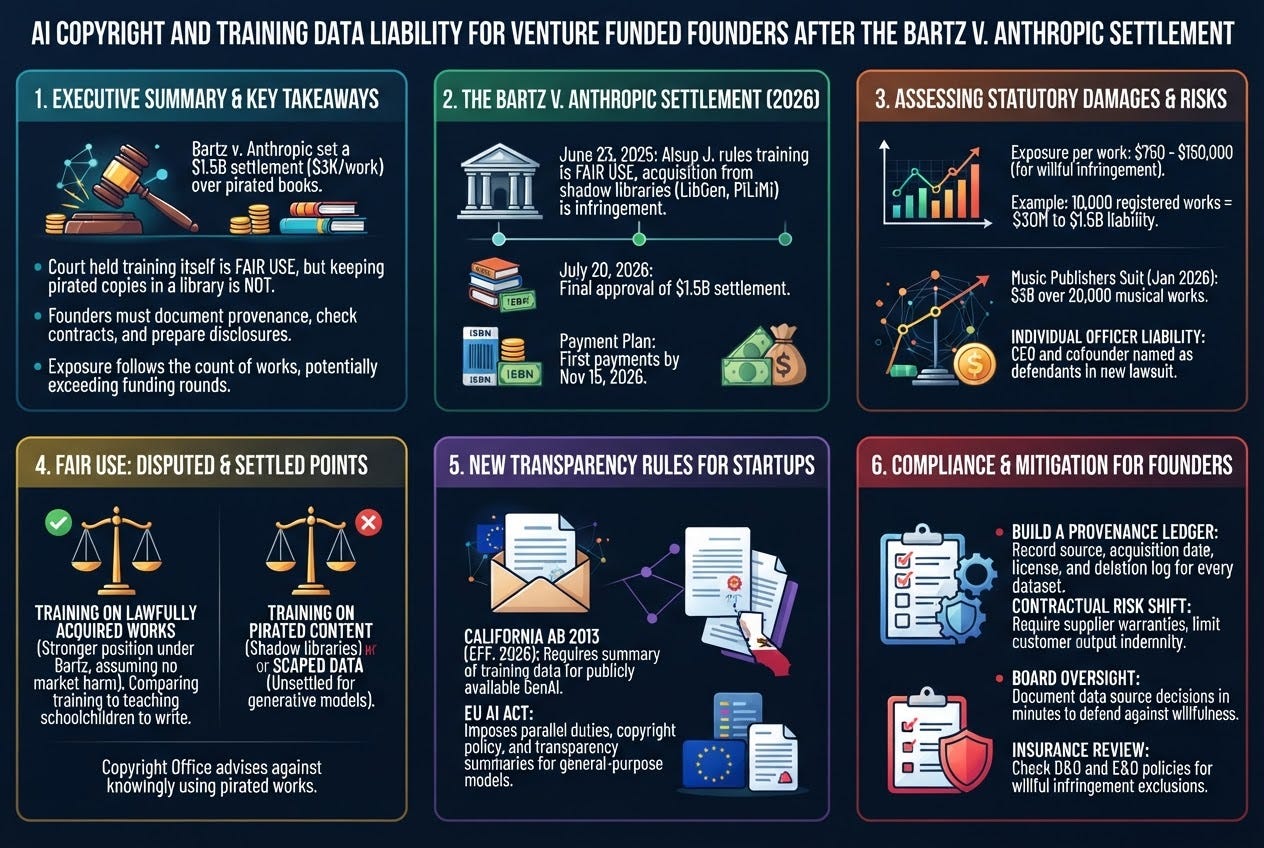
Bartz v. Anthropic settled for $1.5 billion because the company kept pirated books in a permanent library, even though the court held that training on books is fair use. That sentence describes the whole lesson of AI copyright and training data liability for a founder. The ruling of June 23, 2025 protected how Anthropic used the books and punished how it got them, and the district court granted final approval of the settlement on July 20, 2026.
The payment works out to about $3,000 for each of 482,460 registered works. First payments are scheduled on or before November 15, 2026, and the release covers conduct only through August 25, 2025. It does not cover outputs, and it does not license any future training.
How Big Is the Exposure for a Seed Stage Company?
The Copyright Act sets statutory damages at $750 to $30,000 per work and up to $150,000 per work when infringement is willful, under 17 U.S.C. section 504(c). The count of works drives the number. A company that pulled 10,000 registered books from a shadow library faces $30 million at the Bartz rate and a ceiling of $1.5 billion, and most seed and Series A rounds are smaller than either figure.
The music publishers made the arithmetic concrete on January 28, 2026. Concord, Universal Music Group, and ABKCO sued Anthropic for more than $3 billion over more than 20,000 musical works, which matches 20,000 works at the $150,000 ceiling. They found most of those works through discovery in Bartz, and the complaint names the chief executive and a cofounder personally.
Does the Fair Use Ruling Protect Training on Scraped Content?
Not on the current record. Judge William Alsup found training on lawfully acquired books fair use because the model generates new text and does not reproduce the books, and Judge Vince Chhabria found fair use in Kadrey v. Meta on June 25, 2025, but Chhabria wrote that a plaintiff who proves market dilution could win. Neither ruling binds another court, and the Copyright Office stated in May 2025 that knowing use of pirated works weighs against fair use.
Alsup also separated acquisition from use. He held that scanning purchased print books was fair use and that downloading pirated copies was not. A founder who trains on scraped content has no appellate decision upholding fair use for a generative model, and the Kadrey torrenting claim, which concerns distributing copies while downloading them, survived the fair use ruling.
What Did the Third Circuit Add on September 29, 2026?
The Third Circuit affirmed in Thomson Reuters v. ROSS Intelligence that copying Westlaw headnotes to train a legal search tool was not fair use. It was the first federal appellate ruling on fair use in AI training. The panel weighed three factors against ROSS and found that the use harmed two markets: legal research, and a developing market for licensing headnotes as AI training data.
That second market is the one founders should study. The court did not decide whether training a generative model is…
Site web: theinnovationattorney.substack.com


