
Note dell’episodio
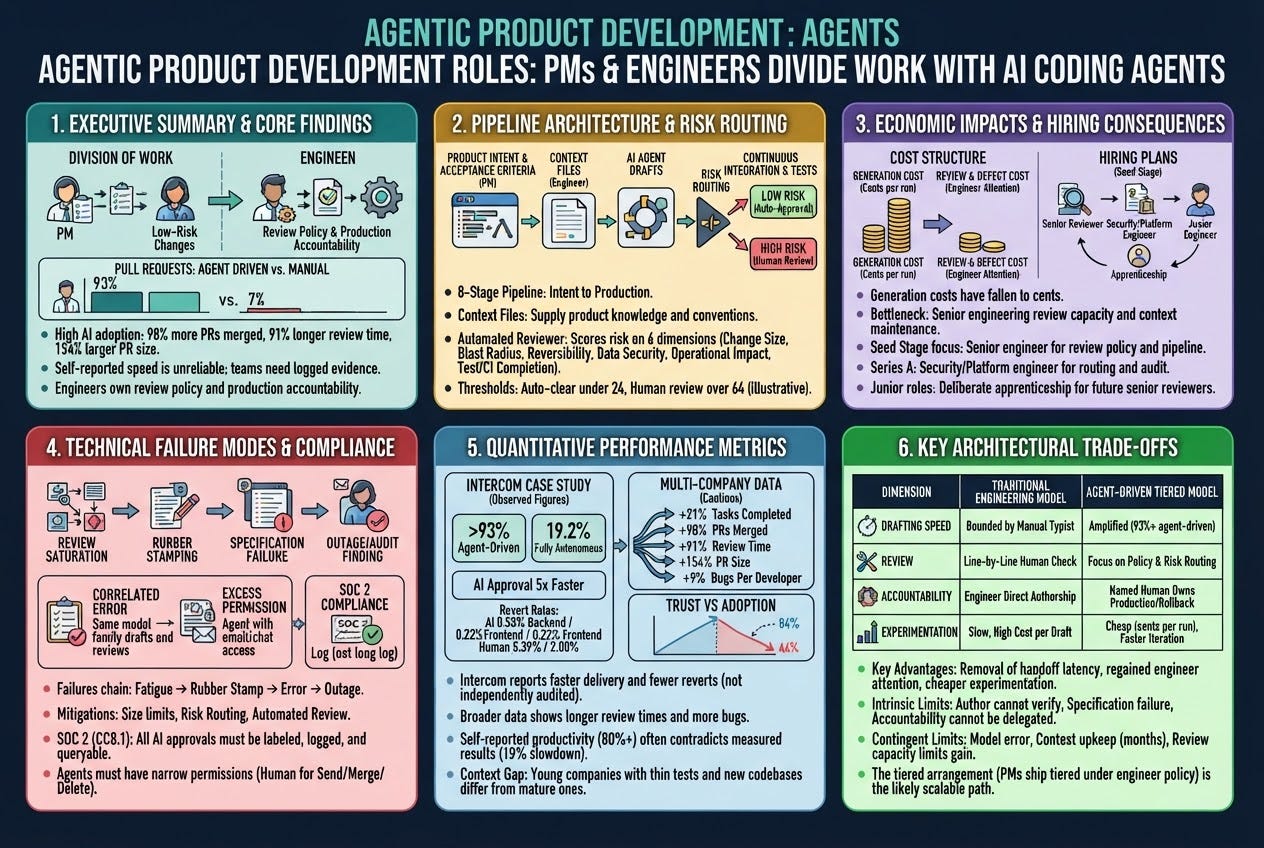
Product managers can ship small, reversible changes alone when AI coding agents write the first draft, while engineers keep review policy, production accountability, and the audit evidence SOC 2 requires. Intercom reported on April 21, 2026 that agents drive more than 93 percent of its pull requests and that 19.2 percent merge with no human reviewer. The number that should hold a founder’s attention sits elsewhere: in a 2025 randomized trial, experienced developers took 19 percent longer with AI tools and still believed they had gone 20 percent faster.
That gap between measured and felt speed explains why the division of labor matters more than the tools. Drafting code now costs cents; one developer reported 73 cents across 23 runs on October 5, 2026. Everything after the draft, meaning review, testing, approval, and the pager, still costs engineer attention, and attention is what a young company lacks.
Why Has Review Become the Bottleneck?
Review is the bottleneck because agents raise the volume and size of changes faster than people can read them. Telemetry from more than 10,000 developers across 1,255 teams found 98 percent more pull requests merged on teams with high AI adoption, with review time up 91 percent and average pull request size up 154 percent. Bugs per developer rose 9 percent. The drafting stage sped up and the queue behind it filled.
I saw the principle at work long before software agents existed. On a nuclear submarine, the watchstander who changed a critical valve lineup was never allowed to verify it; a second, independent person checked it. Whoever makes a change cannot certify it. When an agent drafts code and a product manager clicks approve, nobody independent has looked at the system.
Which Changes Can a Product Manager Ship Alone?
A product manager can ship alone any change that scores low on size, blast radius, reversibility, data and security exposure, operational impact, and test completion. Those six dimensions come from a review bot demonstrated on August 10, 2026, which cleared changes under 24 points as low risk and sent anything above 64 to a human. The thresholds are an illustration from one build. The dimensions travel well.
In practice the list is copy edits, documentation, release notes, configuration values behind a feature flag, internal dashboards, read only queries, and sandbox prototypes with no customer data. One product leader described a workflow on March 11, 2026 where a plain English question becomes SQL that is shown for audit before the answer appears. Showing the query keeps a person in the audit seat.
Authentication, payments, data migrations, personal data, infrastructure, public API contracts, and shared components still need an engineer. Intercom’s own reviewer refuses to approve a change that is too large, complex, or broad until someone splits it.
What Do Engineers Own When Agents Write the Draft?
Engineers own the policy that decides which changes get a line by line read, the context…
Sito web: theinnovationattorney.substack.com


