

Notas del episodio
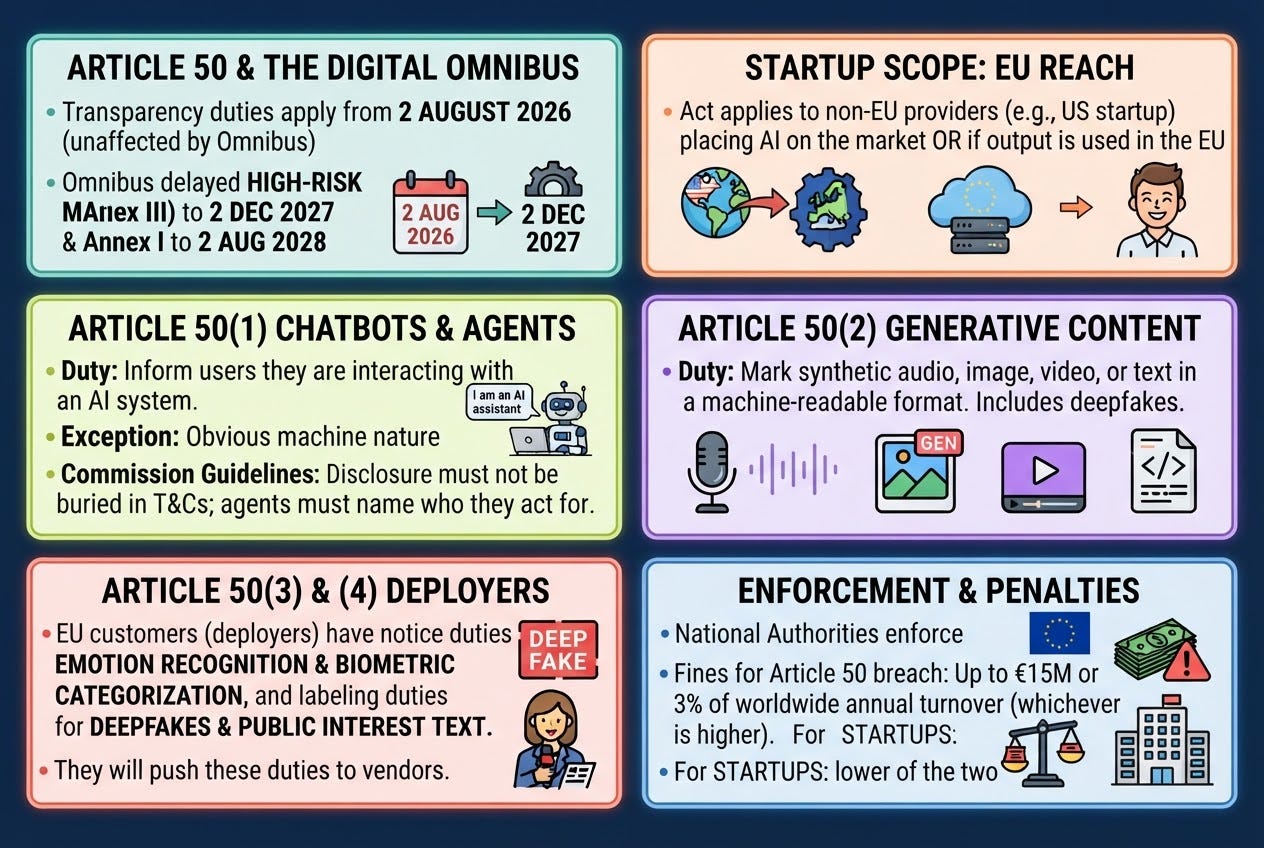
Article 50 transparency obligations under the EU AI Act have applied to United States startups selling AI products in Europe since 2 August 2026, unaffected by the Digital Omnibus. The Digital Omnibus, Regulation (EU) 2026/1744, moved the Annex III high risk deadline to 2 December 2027, and many founders stopped reading there. Article 50 kept its date. A startup that sells a chatbot, an AI agent, or a generative tool to a European customer already owes disclosure and content marking duties, with one grace period that closes on 2 December 2026.
The Omnibus entered into force on 27 July 2026, six days before Article 50 began to apply. The headlines about postponement describe the high risk chapter: standalone Annex III systems now wait until 2 December 2027, and Annex I systems embedded in regulated products until 2 August 2028. Transparency sits in a different chapter, and nobody moved it.
Does a startup without a European office owe Article 50 duties?
Yes. Article 2(1)(a) of the Act applies to providers placing AI systems on the Union market whether they sit in Delaware or Dublin, and Article 2(1)(c) reaches a third country provider whose output is used in the Union. One signed subscription with a German customer makes the startup a provider. The authorized representative requirement in Article 22 belongs to high risk systems, so no European entity is required for Article 50, and none is excused by lacking one.
In thirty years of counseling technology companies, I have seen one pattern repeat with every new set of rules. The customer questionnaire reaches the startup before any regulator does. A European procurement team in October 2026 asks a vendor which Article 50 duties its product meets, and the vendor that cannot produce a dated product inventory answers slowly, and sometimes loses the quarter.
What must the product itself do?
Article 50(1) requires a provider to design an AI system that interacts directly with people so that they are told they are dealing with a machine, unless that is obvious to a reasonably well informed person. For a support bot, a sales agent, or a voice agent, the disclosure belongs in the product by default. The Commission’s guidelines of 20 July 2026 say a disclosure buried in terms and conditions is insufficient, and for an AI agent they add the name of the person on whose behalf it acts.
Article 50(2) requires a provider of a system that generates synthetic audio, image, video, or text to mark the outputs in a machine readable format so that they are detectable as artificially generated. The marking must be effective, interoperable, resilient, and reliable as far as technically feasible. Assistive editing functions that do not substantially alter the input are excepted. A startup that wraps a third party model through an API is the provider of its own application, so the marking duty is the startup’s, whatever the upstream model vendor does.
The Omnibus gave one concession here. A generative system placed on the…
Web: theinnovationattorney.substack.com


