

The Innovation Attorney Podcast
How Should a Synthetic Biology Startup Plan Fermentation Capacity
· 21 mnt
Catatan episode
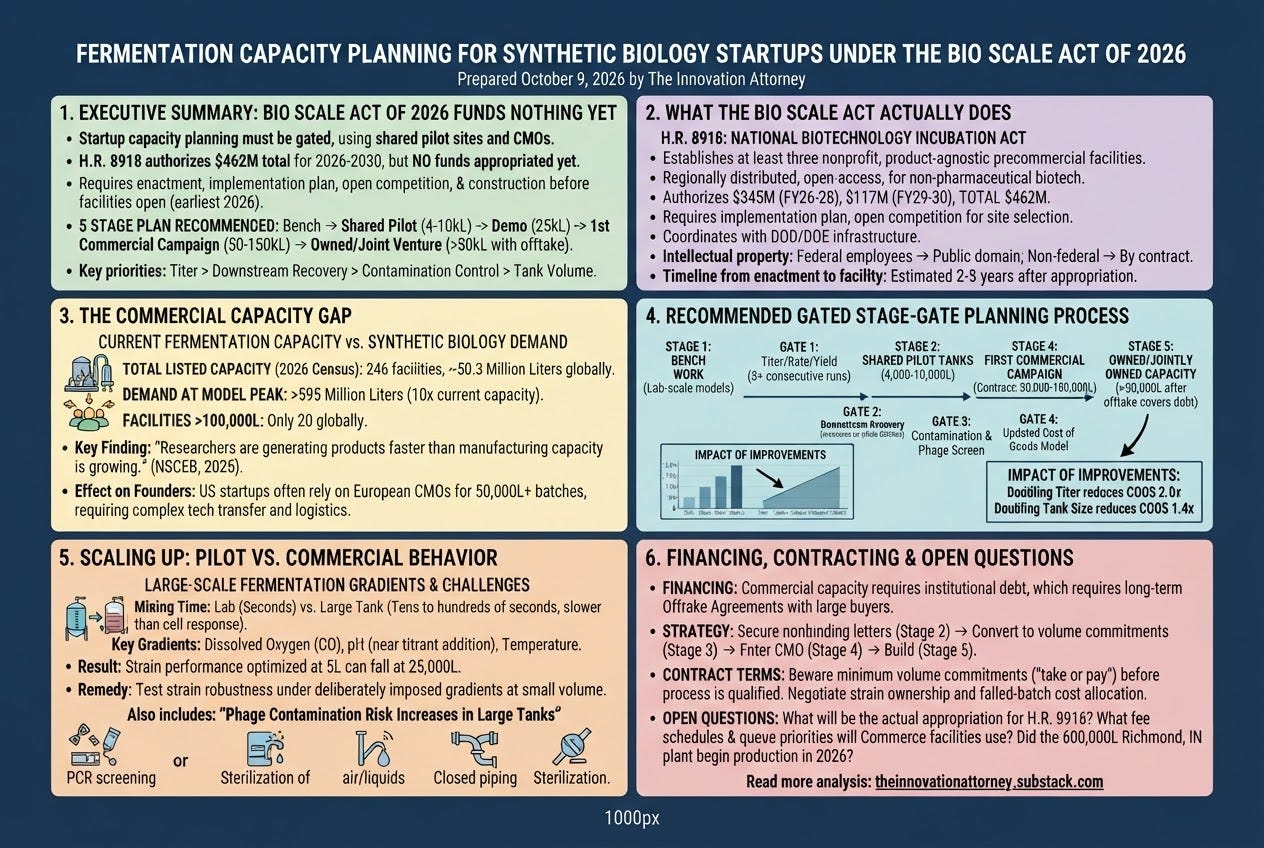
A synthetic biology startup should plan fermentation capacity as gated purchases of evidence, because H.R. 8918, the BIO SCALE Act of 2026, has funded no facility yet.
The bill would direct the Secretary of Commerce to build at least three nonprofit, product agnostic precommercial facilities, with $345 million authorized for fiscal years 2026 to 2028 and $117 million for 2029 to 2030. Before a single tank is welded, though, Commerce owes Congress an implementation plan, then an open competition, then construction. A founder who needs 25,000 liters in 2027 cannot wait for that sequence, and the plan below is built for that founder.
The shortage the bill targets is real and it sits at the top of the size range. The most recent capacity census lists 246 fermentation facilities in more than 40 countries, and only 20 of them have tanks above 100,000 liters. If every company in that database sought the volume of its largest modeled need, the total would pass 595 million liters, over ten times what the census lists. One company that needed 50,000 to 100,000 liter batches of a nylon intermediate went to European contract plants, because few plants in the United States could run them.
Here is the part that surprises people. Tank size is the weaker lever. The same census analysis finds that each doubling of fermentation volume cuts cost of goods about 1.4 fold, while each doubling of titer cuts it twofold. So the first dollars belong to strain work and downstream recovery, and the tank comes after.
A worked example shows how the numbers move. Take a startup selling 1,000 metric tons a year at a titer of 100 grams per liter and 80 percent recovery. That is 80 kilograms per cubic meter of broth, so the company must ferment 12.5 million liters a year. Two 150,000 liter tanks running 70 batches each would cover it. Double the titer to 200 grams per liter and one tank is enough. I built that arithmetic with assumed inputs, and it carries no figure from any real plant, but it explains why a capacity plan written before the strain is finished goes stale.
The staging itself follows the facilities that exist. Stage one is bench work with small vessel models that reproduce the gradients of a large tank. Those gradients are large: mixing takes under 5 seconds in a laboratory vessel and tens to hundreds of seconds in a large one, and in one 30 cubic meter yeast fermentation the glucose near the feed port ran about ten times higher than at the bottom. Stage two is a shared pilot tank, 4,000 liters in Hayward, California or 10,000 liters near Ames, Iowa. Stage three is demonstration volume, up to 25,000 liters at the Maple Grove, Minnesota plant that BioMADE, the Pentagon and Minnesota funded with at least $132 million.
Stage four is a first commercial campaign in contract capacity, roughly 50,000 to 150,000 liters. Stage five is owned or jointly owned capacity, the kind Liberation Bioindustries designed at 600,000 liters in Richmond, Indiana, where production was…
Situs: theinnovationattorney.substack.com


