

The Innovation Attorney Podcast
How Will The ULA Sale Change National Security Launch Pricing
· 22 min
Poznámky k epizodě
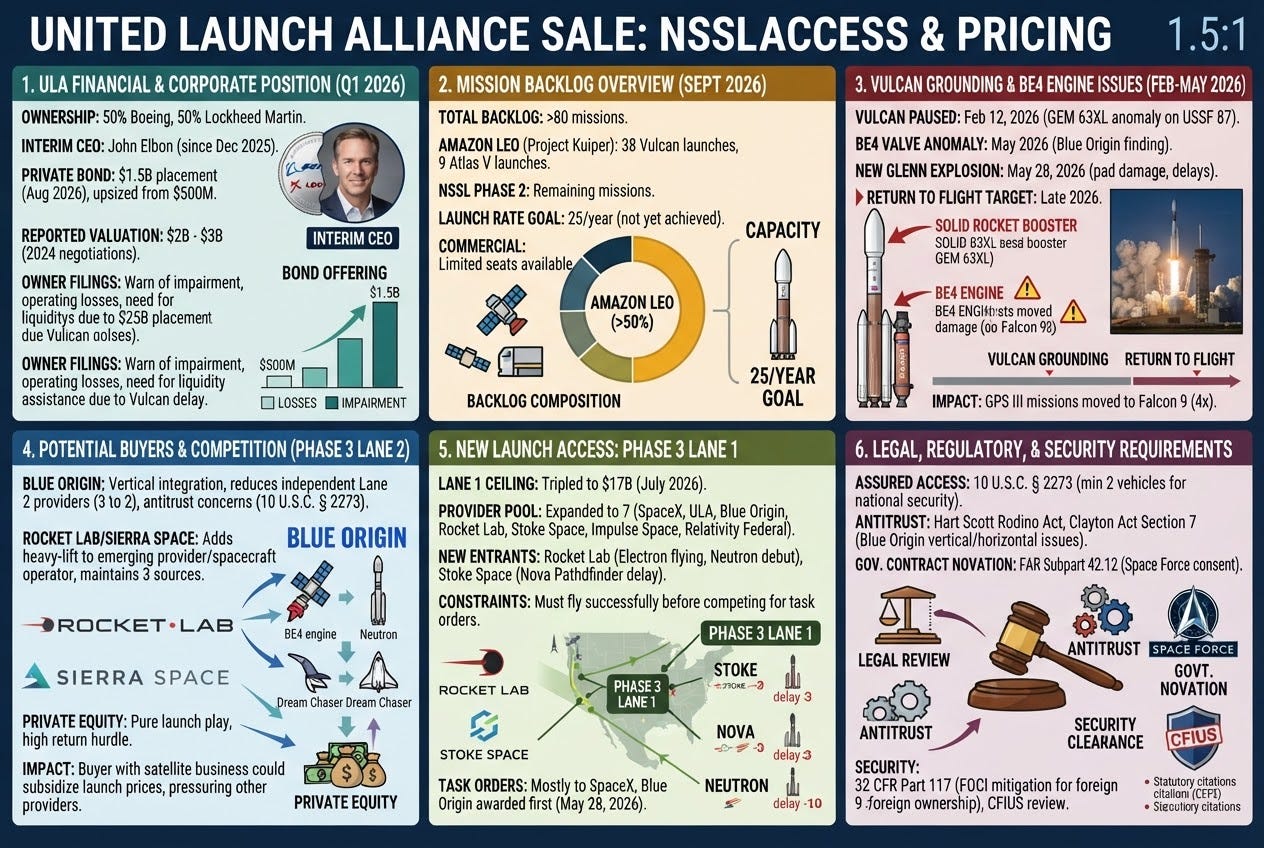
A United Launch Alliance sale would change National Security Space Launch pricing by moving 19 Phase 3 Lane 2 missions, worth over $5.3 billion through 2032, under an owner with different incentives than Boeing and Lockheed Martin. No buyer has been announced. Reports dated September 10, 2026 renewed speculation that the two owners, each holding 50 percent, may sell. A buyer would acquire a company that has not flown a national security mission since February 12, 2026.
That date matters because a solid rocket motor nozzle failed during the USSF 87 launch of a Vulcan rocket. The payloads reached orbit. The Space Force then paused Vulcan from national security work, and on March 20 it moved GPS III satellite vehicle 10 to a SpaceX Falcon 9, the fourth GPS reassignment from Vulcan. A rocket company that keeps losing missions to its competitor is the asset on the table.
What Is ULA Actually Worth to a Buyer?
The last reported price talk came in August 2024, when Sierra Space was reported in negotiations at an informal estimate of $2 billion to $3 billion. Today the company holds a backlog of more than 80 missions, 38 of them Vulcan launches for Amazon Leo, and in August it placed a $1.5 billion private bond, tripled from a $500 million target. The proceeds pay for Decatur tooling, upgrades to launch pads at Cape Canaveral and Vandenberg, and reserves for solid rocket motors and engines, all aimed at 25 launches a year.
Both owners carry the stake at roughly $545 million on their books, and both said in first quarter filings that the Vulcan suspension is hurting the venture and that more support may be needed. In thirty years of counseling technology companies, I have found that language like that in a seller’s filing sets the buyer’s opening bid. A pure launch company also cannot subsidize rocket prices with satellite revenue, which is why a buyer with a constellation or a spacecraft line values it differently than a financial buyer does.
Why Does the Identity of the Buyer Control Launch Prices?
Prices follow incentives. SpaceX lists Falcon 9 at $69.75 million, and Vulcan is estimated near $110 million. Government missions cost more because they include mission assurance. The Lane 2 ceilings imply an average of about $211 million per mission for SpaceX, $280 million for ULA, and $340 million for Blue Origin. Those averages are calculated from the April 2025 awards and are not published prices, and they show a premium of roughly 32 percent for the second source.
A Blue Origin purchase would put the maker of the BE4 engine that powers Vulcan, the owner of New Glenn, and the holder of seven Lane 2 missions together with ULA’s 19. Three independent sources would become two. 10 U.S.C. § 2273 requires at least two launch vehicles able to carry any national security payload, so that outcome meets the statute and leaves no margin. Antitrust review under Section 7 of the Clayton Act would examine it, and so would the Space Force.
A purchase by a company…
Web: theinnovationattorney.substack.com

