

Avsnittsbeskrivning
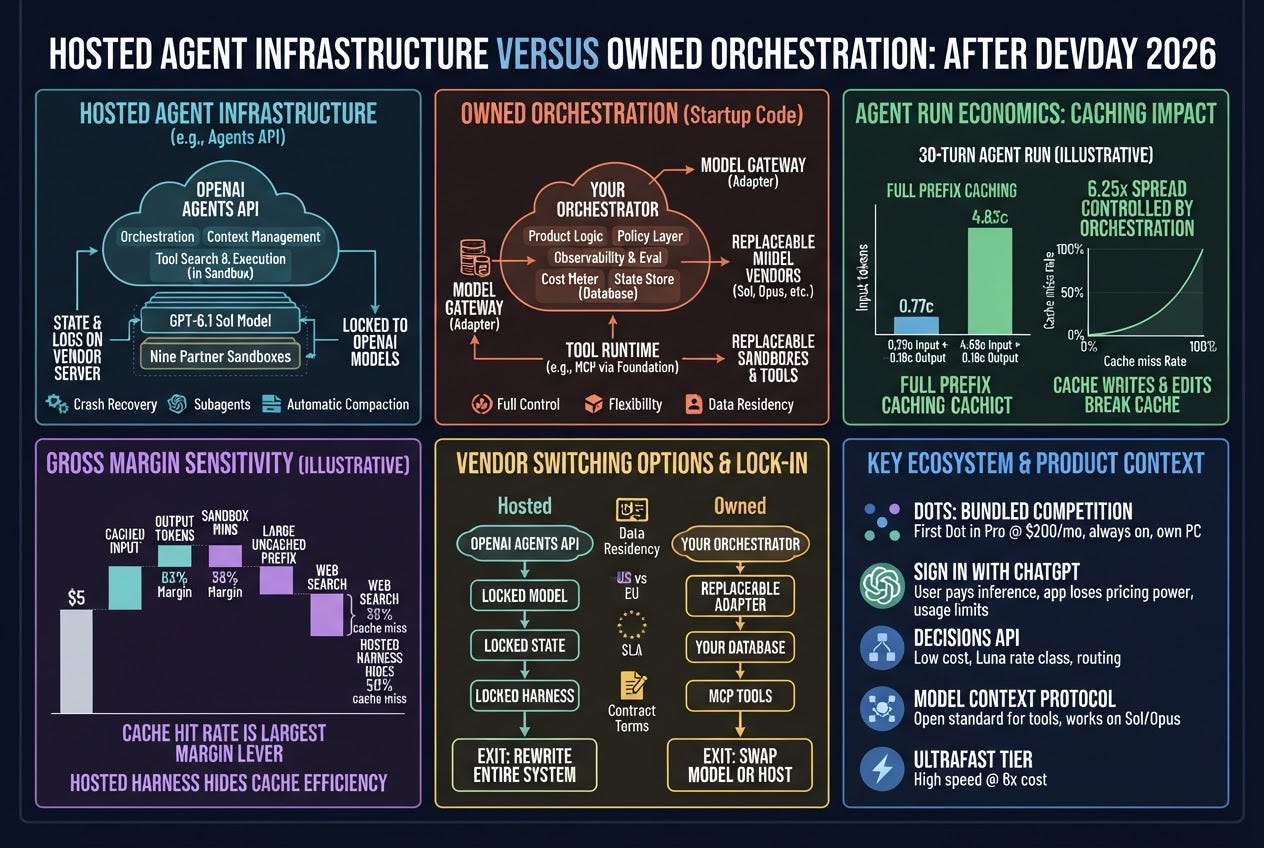
A startup on OpenAI’s Agents API hands over the cost lever that decides its margin on GPT 6.1 Sol, priced at $2 input and $10 output per million tokens.
That lever is the cache hit rate. A 30 turn agent run costs $0.77 when every earlier token is read from cache at $0.10 per million, and $4.83 when none is, a spread of 6.25 times. Keep the loop in your own code, rent the model and the sandbox through adapters, and use the hosted service for internal work until it reaches general availability.
OpenAI announced Sol at its September 29, 2026 developer event, along with Dots, always on agents that carry their own cloud computer, and a widened Agents API that has been in public beta since September 10. The Agents API runs the agent loop on OpenAI’s servers: session state, context compaction, tool search, and subagents. It charges no orchestration fee, and you pay for tokens, tools, and container minutes.
Why does the cache hit rate decide gross margin?
Every turn of an agent loop resends the entire conversation, so input tokens grow with the square of the number of turns. A run that adds 5,000 tokens per turn over 30 turns processes 2.325 million input tokens. Double the turns to 60 and the total climbs to 9.15 million, nearly four times as much.
Caching is what tames that curve. Sol lists cached input at $0.10 per million tokens against $2 for fresh input, plus a cache write rate of $2.50. The discount applies only when a prompt starts with exactly the tokens of an earlier prompt. A summary that replaces old turns, or a tool definition loaded midstream, breaks the match and bills everything after it at the full rate. Prompts above 272,000 tokens also carry a surcharge of twice the input rate, so builders compact context, and compaction edits the prefix. Whoever runs compaction decides the margin.
The Agents API runs compaction and tool search inside OpenAI’s service, and OpenAI has not published how they interact with caching. They may do it well, and nobody outside can tell. My own model of a 30 turn run with a 50 percent prefix miss rate costs $2.84. Charge $5 per task and add sandbox minutes, and the owned loop earns an 83 percent gross margin while the hosted case earns 38 percent. Those are my assumptions, and the only way to replace them with facts is to meter your own workload.
What does hosted agent infrastructure cost beyond tokens?
Container time bills by the minute with a five minute minimum, and the rate is $0.006 per minute for a 4 GB sandbox. An agent that holds that sandbox open all day costs $8.64, which is $259.20 over a 30 day month before a single token.
Sell an always on agent at $99 per month and compute alone loses money. Sell at $200 and you compete with the Pro plan, whose first Dot costs the customer nothing extra. The startups that survive that comparison build agents that sleep: event driven wake ups, checkpoints, and billing for active minutes only. That logic lives in the orchestrator, which is the part you would be…
Webbplats: theinnovationattorney.substack.com


