
Poznámky k epizodě
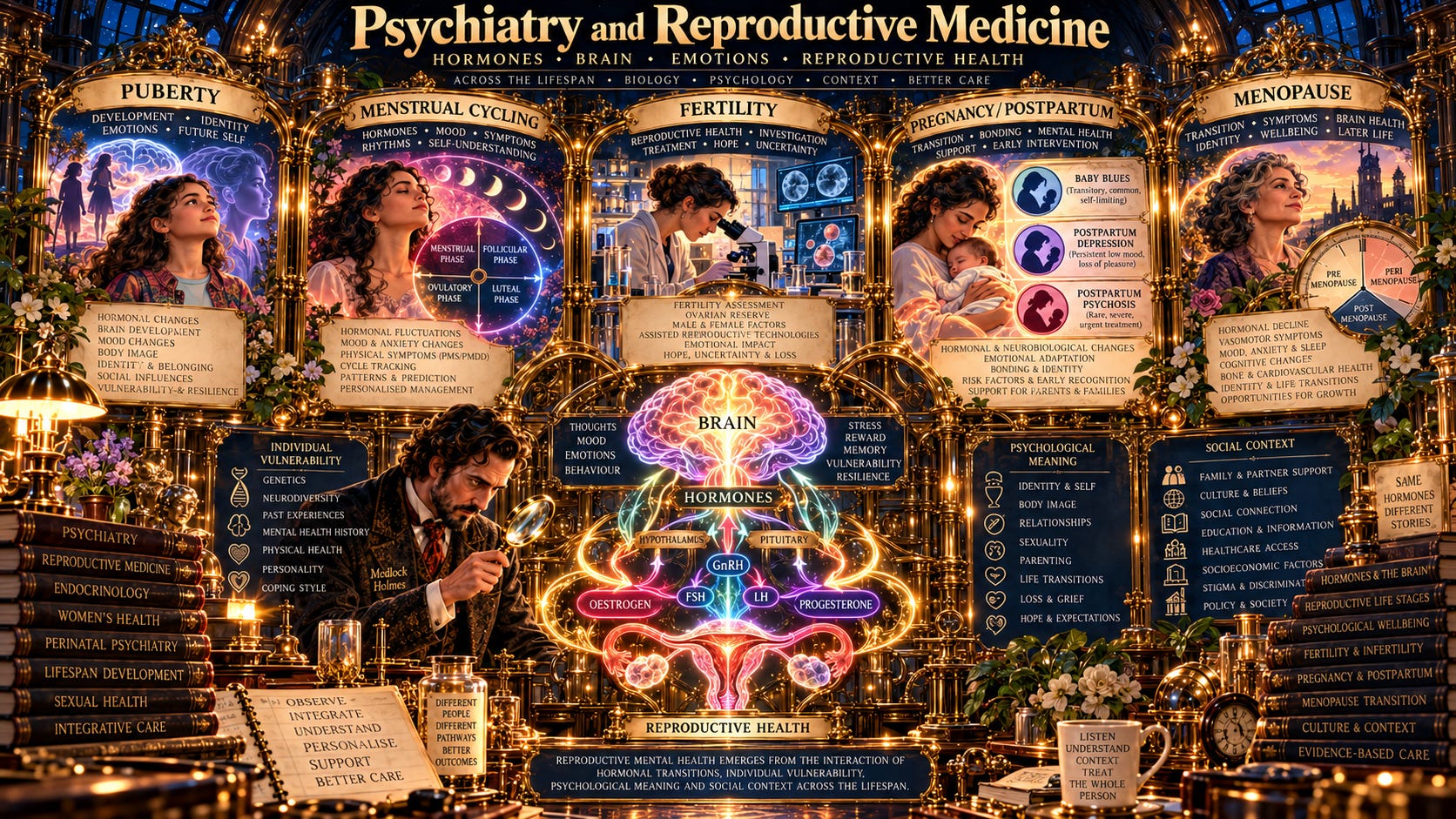
Medlock Holmes investigates the hidden cultural assumptions that shape diagnosis, treatment and the therapeutic relationship.
The House of Many Mirrors
On a fog-covered evening in Victorian London, Medlock Holmes receives a letter from the Royal Institute of Psychiatric Enquiry.
The letter describes an unsettling pattern.
Several patients have received technically accurate psychiatric assessments, yet their treatment has failed. Some have disengaged. Others have rejected diagnoses. A few have described feeling profoundly misunderstood, despite their clinicians’ best intentions.
The Institute’s director asks Holmes a deceptively simple question:
“How can a psychiatrist correctly identify an illness and still fail to understand the patient?”
Holmes enters the House of Many Mirrors, an extraordinary institution where each room reflects a different perspective on the same human experience.
In the first mirror, he sees a patient suffering from depression.
In the second, the same person appears as a migrant struggling with displacement, loss of professional status and separation from family.
In the third, the patient is a parent whose illness threatens a deeply valued family role.
In the fourth, the patient is someone whose previous experiences of discrimination have made psychiatric services feel unsafe.
And in the final mirror, Holmes sees the psychiatrist - carrying their own beliefs about illness, professionalism, autonomy, treatment and what constitutes normal behaviour.
The mystery becomes clear.
Psychiatric assessment is never simply an encounter between a disorder and a diagnostic manual. It is an encounter between two people, each shaped by culture, history and experience.
The First Investigation: The Origins of Cultural Psychiatry
Holmes begins by examining the historical development of cultural assessment.
He discovers that early comparative psychiatry attempted to determine whether psychiatric disorders appeared similarly across societies. Yet these investigations were frequently compromised by racial assumptions, unequal power relationships and the belief that European psychiatric concepts represented universal standards.
Later, the Culture and Personality School proposed that societies produced characteristic personality structures through childhood socialisation.
But Holmes identifies a serious weakness.
A culture cannot be reduced to a single personality type, nor can individuals be understood merely as representatives of their society.
Culture is dynamic. People interpret, negotiate, challenge and transform the traditions to which they belong.
The modern investigation must therefore move beyond asking:
“What does this cultural group believe?”
Towards asking:
“What does this particular person believe, and how have their cultural and social experiences shaped those beliefs?”
The Second Investigation: The Two Maps of Illness
In the Institute’s cartography room, Holmes discovers two maps of the same territory.
The first is labelled…
Web: drmanaankarray.substack.com

